AI for Supply Chain Professionals
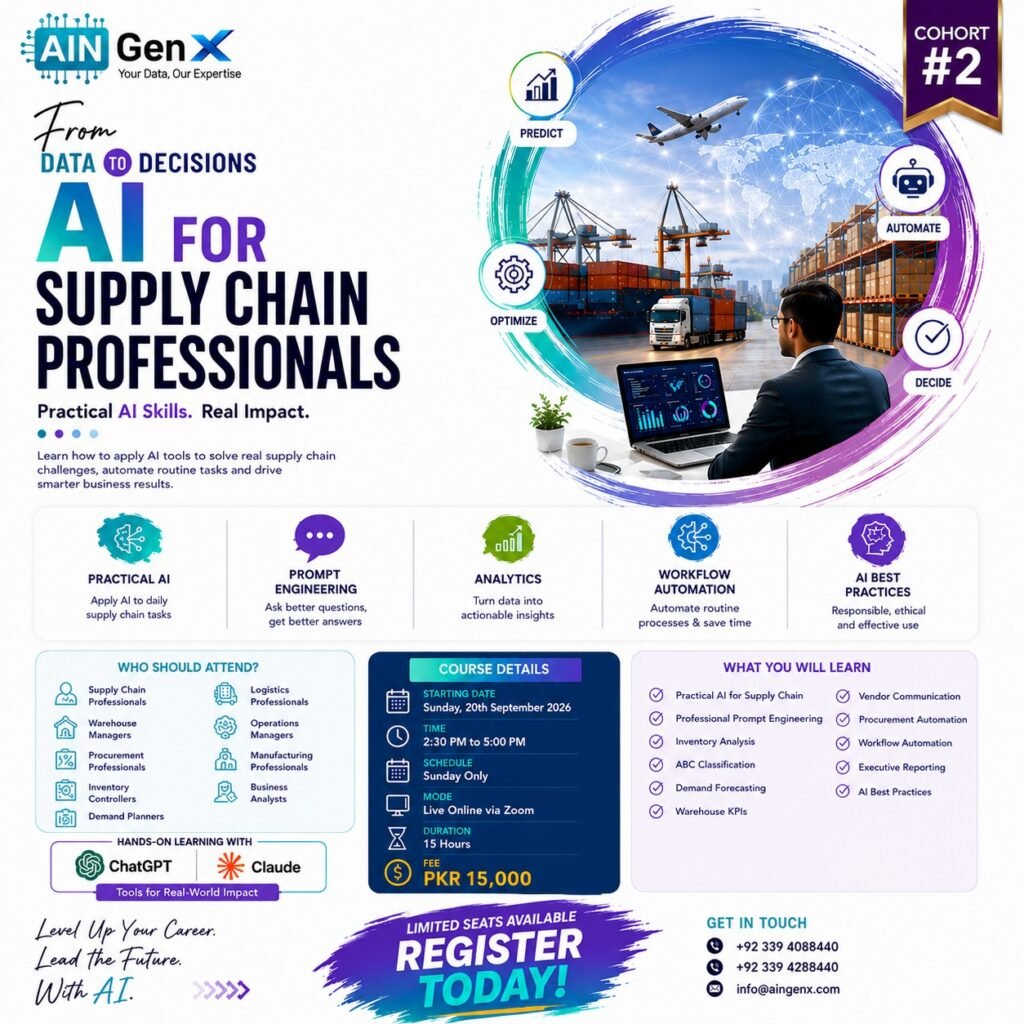
Transform supply chain operations with the power of Artificial Intelligence. This practical training is designed for professionals working in procurement, inventory, logistics, planning, warehousing, and operations. Participants will learn how AI tools such as ChatGPT, Claude, and automation platforms can support demand forecasting, supplier evaluation, inventory optimization, report generation, data analysis, and decision-making. The session focuses on real business scenarios rather than theory, helping participants save time, reduce manual work, improve accuracy, and generate actionable insights. By the end of the training, professionals will understand how to use AI effectively to build a smarter, faster, and more efficient supply chain.
Course Objective:
• Understand practical, day-to-day applications of Generative AI in supply chain operations.
• Use ChatGPT and Claude to complete routine and complex tasks in a fraction of the usual time.
• Improve reporting, analysis, communication and decision-making using AI as a working partner.
• Build a personal, reusable prompt library for common supply chain tasks (using the RCTF framework).
• Apply AI securely and responsibly, protecting company and vendor data at every step.
• Independently solve an end-to-end business problem using AI by the end of the course (capstone).
Outline
Module 1 — Foundations of AI for Supply Chain
Learning objective: Understand what Generative AI can and cannot do for supply chain work, and learn the building blocks of an effective prompt using the RCTF framework.
Theory
• What is AI vs. Generative AI, in plain terms
• ChatGPT vs. Claude: strengths, differences, when to use which
• Where AI creates value across the supply chain
• Limitations, hallucination risk, and responsible use
• Data privacy and confidentiality basics
• Anatomy of an effective prompt
• The RCTF framework: Role, Context, Task, Format
• Output formatting control (tables, memos, bullet structures)
• Common prompting mistakes and how to spot them
Module 2 — Prompt Engineering for Supply Chain
Learning objective: Apply the RCTF framework to diagnose weak prompts and build a personal, reusable prompt library.
Hands-on practice
Case study: a poorly worded RFQ follow-up email and a vague internal request.
• Diagnose and rewrite 4 weak prompts using RCTF
• Build 3 reusable prompt templates for the participant's own recurring tasks
• Peer-review exchange: critique a colleague's prompt template
Tools: ChatGPT and Claude, free or paid.
Take-away: A personal prompt template library (3–5 templates) to reuse after the course.
Module 3 — AI for Daily Office Communication
Learning objective: Produce polished, business-ready written communication in English and Urdu using AI as a first-draft partner.
Theory
• Structuring professional emails and escalations
• Meeting agendas and minutes from raw notes
• English–Urdu translation: what AI gets right and where to double-check
Hands-on practice
Case study: a vendor delivery delay requiring escalation, plus messy meeting notes.
• Draft a firm-but-professional vendor escalation email
• Convert raw meeting notes into structured minutes with action items
• Translate a short business email EN→UR and UR→EN, and sanity-check tone
Tools: ChatGPT and Claude, free or paid.
Take-away: Three ready-to-send communication drafts the participant can adapt immediately.
Module 4 — A Day in the Warehouse: Spotting AI Opportunities
Learning objective: Practice recognizing where AI can help inside a real, messy operational scenario — before being taught any function-specific technique.
Hands-on practice
Case study: a mid-size distributor's messy daily operations log.
• Identify 5 points in the case where AI could help, and why
• Write and refine a first prompt against the case using both tools
• Compare ChatGPT's and Claude's responses side by side
Tools: ChatGPT (free) and Claude (free) — no paid features required.
Take-away: A personal one-page 'AI opportunity map' for the participant's own role.
Module 5 — Warehouse & Inventory Management
Learning objective: Use AI to analyze inventory data and produce a defensible action plan, not just raw numbers.
Theory
• ABC analysis logic
• Recognizing slow-moving and dead stock
• Core warehouse KPIs and what they signal
Hands-on practice
Case study: a pre-cleaned, anonymized FMCG warehouse inventory extract.
• Run an AI-assisted ABC analysis and sanity-check the output
• Flag slow-moving/dead stock and estimate stockout risk
• Generate a reorder plan and a short improvement recommendation for management
Tools: ChatGPT and Claude; paid-tier data-analysis features shown as an enhancement for larger real datasets.
Take-away: A one-page inventory action memo, AI-drafted and participant-reviewed.
Module 6 — Procurement & Vendor Management
Learning objective: Use AI to compare vendors and review contracts faster, while keeping judgment in human hands.
Theory
• What a good RFQ comparison actually measures
• Vendor evaluation and scorecard criteria
• Where AI helps in contract/PO review — and where it can miss risk
Hands-on practice
Case study: three anonymized sample vendor quotations for the same item.
• Build an AI-assisted RFQ comparison table
• Score vendors against a simple scorecard
• Review a short sample PO/contract clause set and flag risk language
Tools: ChatGPT and Claude, free or paid.
Take-away: A vendor comparison table and scorecard ready to present to a manager.
Module 7 — Planning, Forecasting & Production Support
Learning objective: Use AI to build a first-pass forecast and stress-test a production plan against constraints.
Theory
• Demand forecasting: what inputs matter
• Capacity and material planning basics
• Scenario ('what-if') analysis
Hands-on practice
Case study: a short, anonymized sales history for a single product line.
• Generate an AI-assisted demand forecast and question its assumptions
• Draft a production/capacity plan from the forecast
• Run a what-if scenario (e.g. a supply delay) and identify the bottleneck
Tools: ChatGPT and Claude, free or paid.
Take-away: A forecast summary plus one scenario analysis, ready to discuss with planning.
Module 8 — Reporting, Dashboards & Decision Making
Learning objective: Turn raw KPI data into a clear executive narrative and a management recommendation.
Theory
• Executive summary structure
• Reading and interpreting KPIs correctly
• Root cause analysis and business storytelling
Hands-on practice
Case study: a short raw KPI dataset (on-time delivery, cost, fill rate) needing a story.
• Draft an executive summary from the raw KPIs
• Build a root-cause narrative for a KPI miss
• Outline an AI-assisted presentation and a one-paragraph management recommendation
Tools: ChatGPT and Claude, free or paid.
Take-away: An executive summary and presentation outline, ready to adapt for real reporting.
Module 9 — Capstone Assessment (+ Optional Bonus Preview)
Learning objective: Independently solve an integrated, multi-function business case using AI, end to end.
Theory
• Recap of the RCTF framework and course toolkit
• Optional 15-min preview: no-code app-building with Google AI Studio / Claude Artifacts (bonus, not assessed)
Hands-on practice
Case study: a single scenario spanning warehouse, procurement and planning issues together.
• Work independently (or in pairs) to diagnose the case and produce a recommendation using AI
• Present the recommendation in 3–5 minutes to the group
• Submit a short written reflection: what worked, what needed human judgment
Tools: ChatGPT and Claude; optional bonus uses Google AI Studio or Claude Artifacts, self-paced after the course.
Take-away: Graded capstone deliverable, and an optional take-home bonus exercise: build a simple inventory tracker app.
Course Fee
● Online
Rs. 15,000/- Total
- Once paid, the fee is non-refundable and non-transferable
Account Details
Bank: Habib Bank Limited
Account Title: AIN GenX
Account No: 5910-70000512-03
IBAN No: PK08 HABB 0059 1070 0005 1203
Facilitators

Irfan Bakaly
Data Analyst
25+ years of experience in Data Analysis

Noor Surani
Tech Entrepreneur
25+ years of experience in Data Analysis

Tamkeen Ahmed
Warehouse & Supply Chain Leader
18+ years, MBA
Who this course is for:
Supply chain, warehouse, procurement, planning, logistics and operations professionals in Pakistan
Duration
● 6 Weeks (15 Hours)
Classes
● Online via Zoom
Schedule
- Day: Sunday's Only
- Timing: 02:30 - 05:00 pm (PST)
Starting From
● Sunday, 20 September, 2026
Participants from Top Organizations











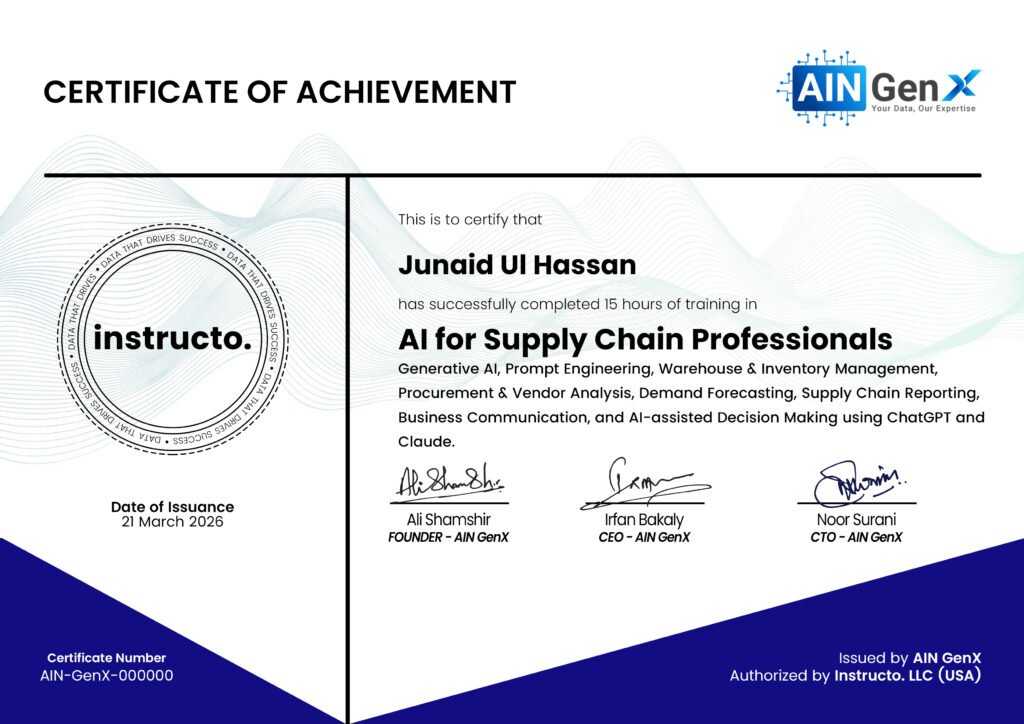
Certificates