Forward Deployed Engineering (FDE)
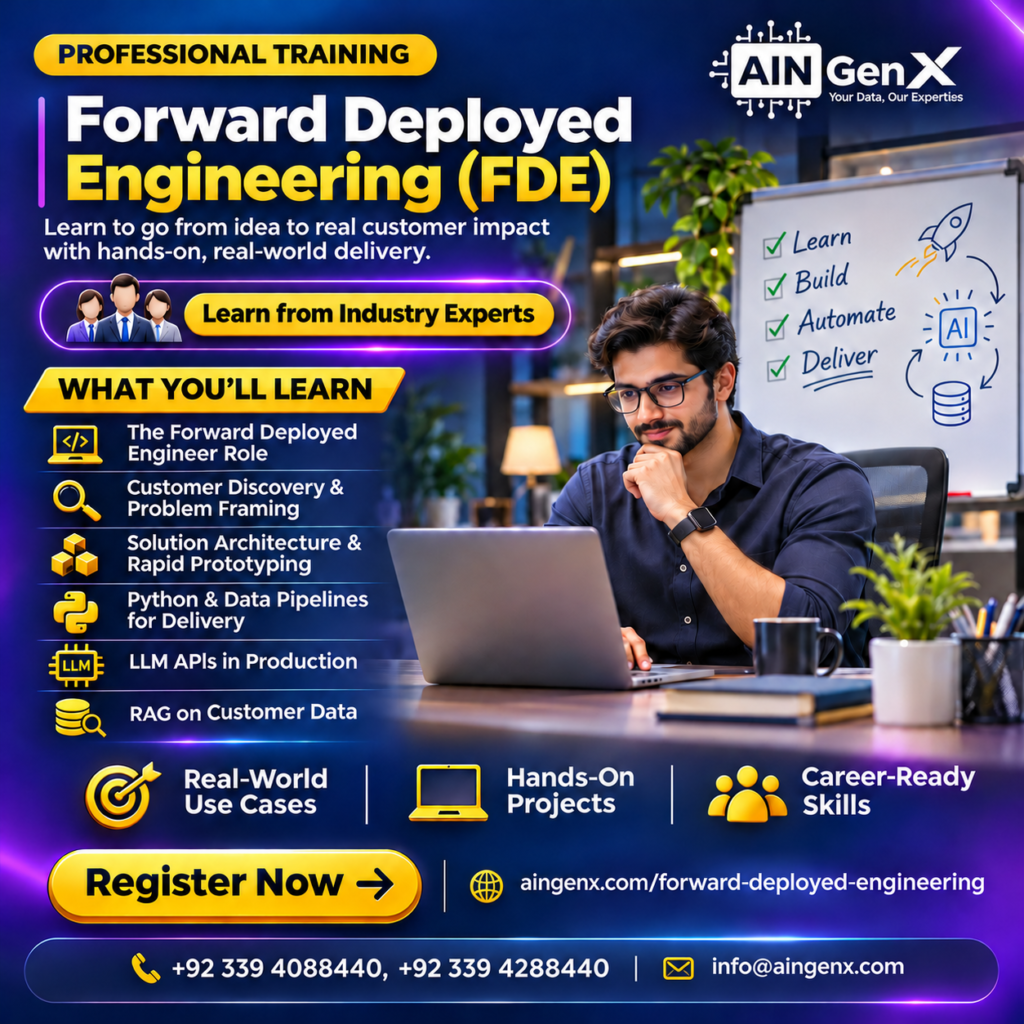
Transform your technical skills into real business impact! Forward Deployed Engineering (FDE) is an emerging approach that connects technology, AI, and customer needs to deliver practical business solutions. Our FDE Training Program equips professionals with hands-on skills in customer discovery, solution architecture, Python, data pipelines, LLM APIs, and Retrieval-Augmented Generation (RAG). Participants will learn how to develop prototypes, integrate AI into business workflows, and deploy customer-focused solutions. Bridge the gap between innovation and implementation. Build practical expertise, solve real-world challenges, and accelerate your career in AI-driven engineering.
Outline
Course Overview
• Turns working engineers into forward-deployed engineers who deliver production AI.
•The cohort runs one simulated customer engagement from discovery to executive readout.
•Every participant finishes with a deployed system and a written case study.
• The program leads with Claude and ends with AWS and Azure demos.
Who Should Attend
• Software, data, and machine learning engineers moving into customer-facing roles.
• Solutions engineers, architects and technical consultants who want to own production code.
• Engineering leaders setting up a forward-deployed function.
Prerequisites
• Basic Python and SQL, plus comfort with Git and the command line.
• Basic familiarity with REST APIs.
• A laptop that runs Docker, a GitHub account, and an Anthropic API key.
• No prior experience with large language models or agents is required.
What You Will Be Able to Do
• Run discovery and turn a vague request into a scoped, measurable problem.
• Design the target workflow with a baseline, a target metric, and acceptance criteria.
• Build Claude applications in Python with tools, retrieval, and structured outputs.
• Connect enterprise systems through the Model Context Protocol (MCP).
• Build agents with sub-agents, Skills, and human approval steps.
• Write evaluations that gate every release and prove business outcomes.
• Deploy, monitor, and control the cost of a production AI service.
• Pass a customer security review and hand over to a named owner.
Platform and Stack
• Models: Claude Haiku, Sonnet and Opus through the Anthropic API.
• Languages: Python as primary, with SQL.
• Agent tooling: Claude Code, Claude Agent SDK, MCP servers, sub-agents, and Skills.
• Application and data: FastAPI, PostgreSQL with pgvector.
• Quality and delivery: pytest, Docker and GitHub Actions.
• Cloud: Amazon Bedrock and Microsoft Foundry, shown as instructor demos.
The Running Engagement
• The customer is a mid-size insurer with a claims team buried in document intake.
• The case supplies messy claims data and a partly documented legacy claims system.
• It also has a cautious security team and a sponsor who wants a number.
How Each Weekend Runs
Saturday: Concept and live build
Sunday: Team sprint and customer simulation
Month 1: Frame the Problem
Week 1: The FDE Role and the Claude Platform
• Saturday: FDE role, engagement lifecycle, eleven domains and a baseline self-assessment.
• Sunday: First Claude API call in Python, then the sponsor kickoff simulation.
• Deliverable: A working starter service and a personal baseline.
• Framework domains: 5 and 9.
Week 2: Discovery and Problem Framing
• Saturday: Stakeholder mapping, discovery interviews and separating symptoms from root causes.
• Sunday: Live interviews with claims, security and finance, then a go, reshape or stop call.
• Deliverable: A one-page problem brief with a stakeholder map.
• Framework domains: 1 and 9.
Week 3: Workflow Design and Value Definition
• Saturday: Current workflow, human approval points, baseline metric and the no-new-software option.
• Sunday: Thin prototype built with Claude Code, then a scope negotiation simulation.
• Deliverable: A workflow map, value case and agreed scope.
• Framework domains: 2 and 10.
Week 4: Prompting and Document Extraction
• Saturday: System prompts, structured outputs and reading claim documents with vision.
• Sunday: Build claims extraction, then compare Haiku, Sonnet and Opus on cost and quality.
• Deliverable: An extraction service with a model selection note.
• Framework domains: 5, plus AI and agent engineering.
Module 1 — Vibe Coding Fundamentals: Build & Launch Your First Website
1. Introduction to Vibe Coding & AI-Assisted Development
• What is Vibe Coding?
• Traditional coding vs. AI-assisted development
• Frontend vs. backend — explained for non-technical users
• Where AI helps and where human judgment is still required
2. Prompt Engineering for Vibe Coding
• How to ask ChatGPT to act as a web developer
• Context, Task, Instructions, and Data
• Turning a simple request into a development prompt
• Creating a website master prompt
• Asking AI to improve its own prompt
• Providing screenshots/reference designs
• Prompting for UI/UX
• Prompting for mobile responsiveness
• Debugging through prompts
3. Building a Website with ChatGPT
• Understanding ChatGPT's website-building capabilities
• Creating the first website
• Creating additional pages
• Navigation between pages
• Headers and footers
• About, Services, Courses, Products, Contact, etc.
• Calls-to-Action
• Responsive/mobile-friendly design
4. Working with Markdown & AI Instruction Files
• What is Markdown?
• .md files explained
• Why AI development increasingly uses Markdown
5. VS Code for Complete Beginners
• What is VS Code?
• Installing and setting it up
• Opening a project folder
• Understanding Explorer
• Creating/editing files
6. Git & GitHub for Beginners
• What is GitHub?
• Why developers use GitHub
• Creating a GitHub account
• Creating the first repository
• Connecting the local website/project
• Pushing website files to GitHub
• Updating the website and pushing changes
7. Hosting, Domains & Going Live
• What is hosting?
• What is a domain?
• DNS explained for non-technical users
• Localhost vs. live website
• Free vs. paid hosting
• Connecting GitHub to a deployment platform
• Publishing the website
• Updating the live website after deployment
Month 2: Build the System
Week 5: Data and Retrieval
• Saturday: Data profiling, SQL, access permissions and regulated-data rules for claims.
• Sunday: Build retrieval over policy documents with pgvector and cited answers.
• Deliverable: A retrieval service and a data quality report.
• Framework domains: 4 and 8.
Week 6: Tools, MCP and Legacy Systems
• Saturday: Tool use with Claude and building an MCP server in Python.
• Sunday: Read and modify the legacy claims code, then expose it through MCP.
• Deliverable: A secured MCP server with architecture decision records.
• Framework domains: 3 and 5.
Week 7: Agents, Sub-agents and Skills
• Saturday: The agent loop, Claude Agent SDK, sub-agents, Skills and common failure modes.
• Sunday: Build the triage agent with human approval for high-value claims.
• Deliverable: A working agent with three tools and an approval step.
• Framework domains: 5, plus AI and agent engineering.
Week 8: Evaluation and Outcome Measurement
• Saturday: Test sets, code, model and human graders, fairness checks and regression suites.
• Sunday: Add the evaluation suite to CI, then run the customer acceptance test.
• Deliverable: An evaluation suite that gates releases, with a results report.
• Framework domains: 6.
Month 3: Ship and Land
Week 9: Production Deployment and Reliability
• Saturday: Containers, CI/CD, logging, token cost tracking, prompt caching and model version pinning.
• Sunday: Deploy the containerized service, write the runbook and name the customer owner.
• Deliverable: A deployed service, a runbook and a model replacement plan.
• Framework domains: 7.
Week 10: Security and Governance
• Saturday: Threat modeling, prompt injection, least privilege, audit logs and user transparency.
• Sunday: Teams red-team each other, then face a mock security review and incident.
• Deliverable: A threat model, a security packet and a passing retest.
• Framework domains: 8.
Week 11: Adoption, Handover and Cloud Demos
• Saturday: Adoption planning, handover, follow-on scoping and reusable assets with confidentiality rules.
• Sunday: Instructor demo of the same agent on Amazon Bedrock and Microsoft Foundry.
• Deliverable: An adoption plan, handover package and product feedback memo.
• Framework domains: 9, 10 and 11.
Week 12: Assessment and Executive Readout
• Saturday: Individual graded practical on a new scenario.
• Sunday: Team executive readouts, exit self-assessment and cohort retrospective.
• Deliverable: The deployed system, a written case study and the readout.
• Framework domains: All eleven.
AWS and Azure Demos
• The trainer shows the course agent running on Amazon Bedrock and Microsoft Foundry.
• The demos cover the model swap, identity, guardrails and monitoring on each cloud.
• Cloud content is demo-only and is not graded.
• Participants who want hands-on practice sign up for a free account or bring their own.
• Free credits may not cover Claude usage, so check before starting.
• A one-page map links each Claude feature to its Bedrock and Foundry equivalent.
Capstone Engagement
• A deployed Claude agent system for the claims case.
• An evaluation report against the acceptance criteria and value metric.
• A security review packet with the threat model and red-team results.
• A handover package with runbook, decision records and adoption plan.
• A two-page written case study for a portfolio or interview.
Course Fee
Rs. 40,000/- Total (lump-sum payment)
Rs. 48,000/- Total (2 x monthly Installment)
- Once paid, the fee is non-refundable and non-transferable
Account Details
Bank: Habib Bank Limited
Account Title: AIN GenX
Account No: 5910-70000512-03
IBAN No: PK08 HABB 0059 1070 0005 1203
Facilitators
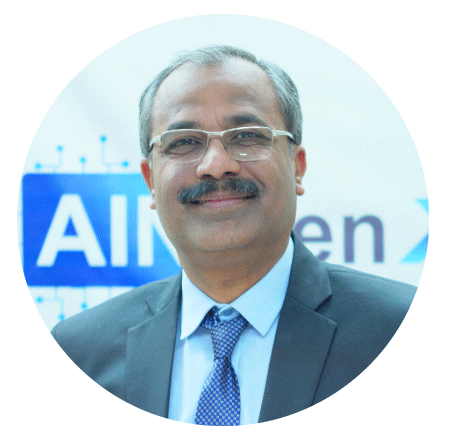
Irfan Bakaly
Data Analyst
27+ years of experience in AI & Data Analytics

Noor Surani
Tech Entrepreneur
27+ years of experience in Data Analysis
Who this course is for:
Software Engineers & Developers, AI & Machine Learning Professionals, Data Analysts & Data Engineers, IT Professionals & Solution Architects etc,
Duration
● 3 months (60 Hours)
Classes
● Online via Zoom
Schedule
- Day: Sat & Sun Only
- Timing: 06:30 - 09:00 pm (PST)
Starting From
● Sunday, 6 December, 2026
Participants from Top Organizations








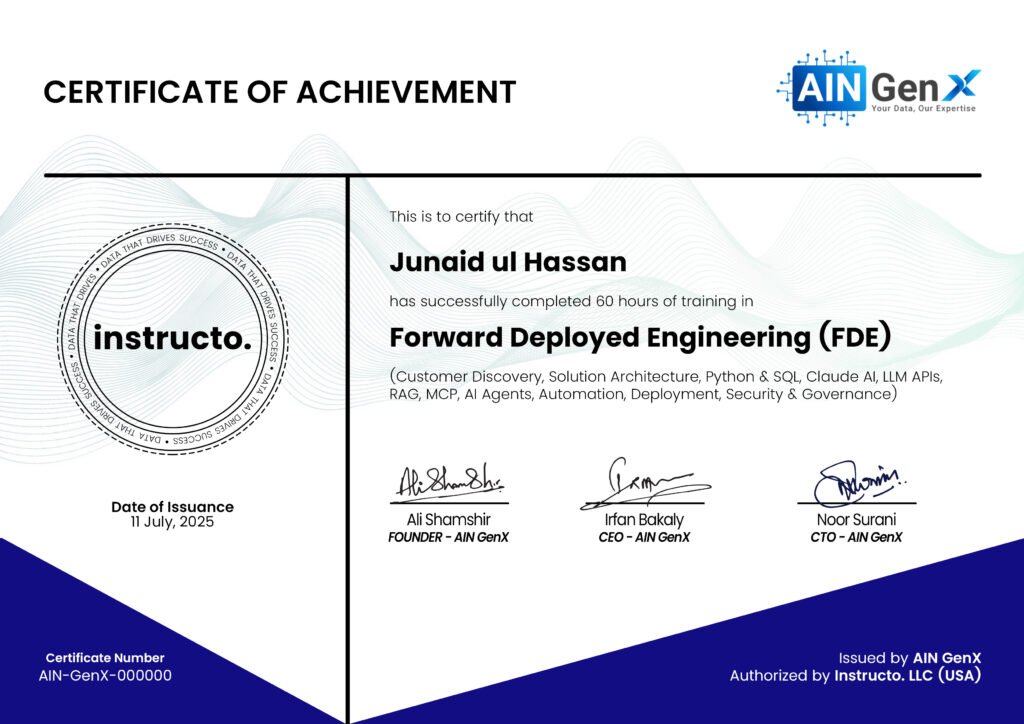
Certificates